Montessori School Curriculum: Fostering Independence and Creativity
Montessori schools have gained popularity over the years for their unique approach to education that focuses on fostering independence, creativity, and a love for learning in children. Central to the Montessori philosophy is the belief that children are natural learners who thrive in an environment that allows them to explore, discover, and learn at their own pace. One of the key components of a Montessori education is its curriculum, which is carefully designed to support the development of each child’s individual strengths and interests.
The Montessori curriculum is structured to provide a hands-on, experiential learning experience that emphasizes practical life skills, sensory exploration, and creative expression. Children are encouraged to engage in self-directed activities that support their physical, emotional, and cognitive development. The curriculum is divided into different areas of study, including practical life skills, sensorial activities, language development, mathematics, cultural studies, and the arts.
In the practical life area, children engage in activities that help them develop fine motor skills, concentration, and independence. These activities may include pouring and transferring objects, buttoning and zipping clothes, and caring for plants and animals. Through these activities, children learn important life skills that will serve them well both inside and outside the classroom.
Sensorial activities in the Montessori curriculum focus on stimulating the child’s senses through activities that involve touch, sight, sound, taste, and smell. These activities help children develop their sensory perception, critical thinking skills, and creativity. For example, children may work with materials that help them differentiate between different textures, colors, and shapes.
Language development is another key component of the Montessori curriculum. Children are exposed to a rich language environment that includes opportunities for listening, speaking, reading, and writing. Montessori materials such as sandpaper letters, movable alphabet, and language cards help children develop phonemic awareness, vocabulary, and reading skills in a fun and engaging way.
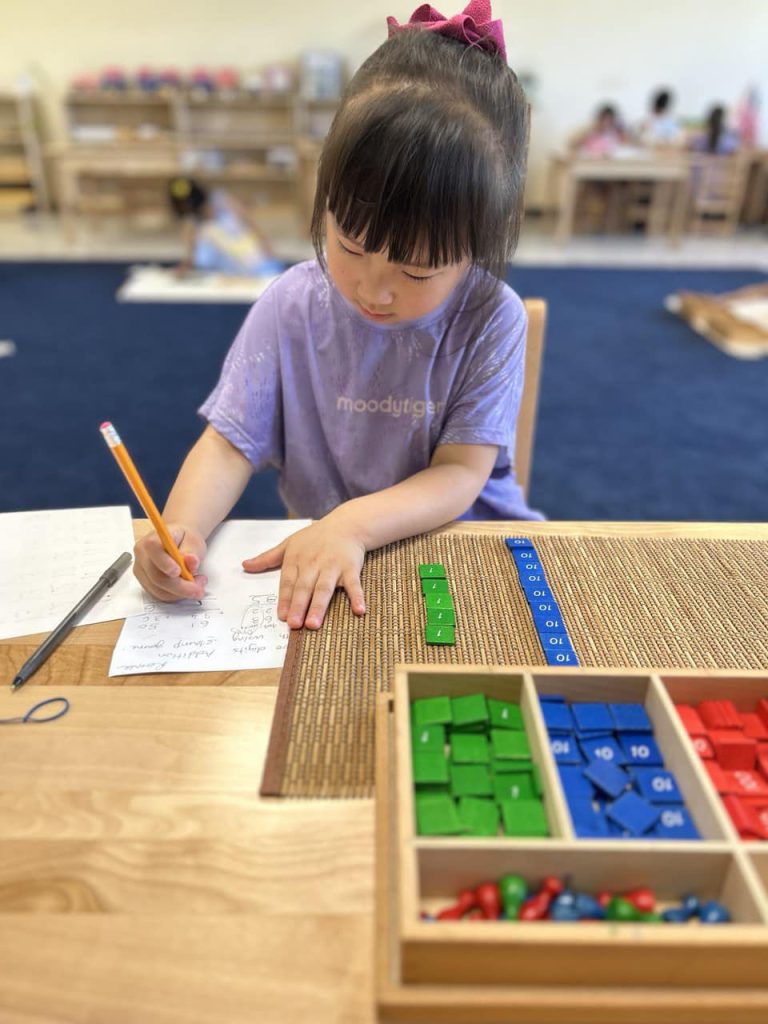
In mathematics, children learn math concepts through hands-on materials that allow them to explore and manipulate numbers and symbols. Montessori materials such as the number rods, golden beads, and spindle boxes help children develop a deep understanding of mathematical concepts such as addition, subtraction, multiplication, and division.
Cultural studies in the Montessori curriculum focus on introducing children to the world around them, including geography, history, science, and the arts. Children develop an appreciation for different cultures, traditions, and perspectives through hands-on activities and experiences. Art and music are also an integral part of the Montessori curriculum, allowing children to express themselves creatively and develop their aesthetic sensibilities.