
– Dr. Maria Montessori
At Pinnacle Montessori, we believe in nurturing the potential of every child through a thoughtfully designed primary classroom that fosters a harmonious blend of age groups, welcoming children from ages 3 to 6. Our environment seamlessly integrates practical life skills and sensory activities with essential social and academic learning, creating a rich tapestry of experiences that ignite a love for learning.
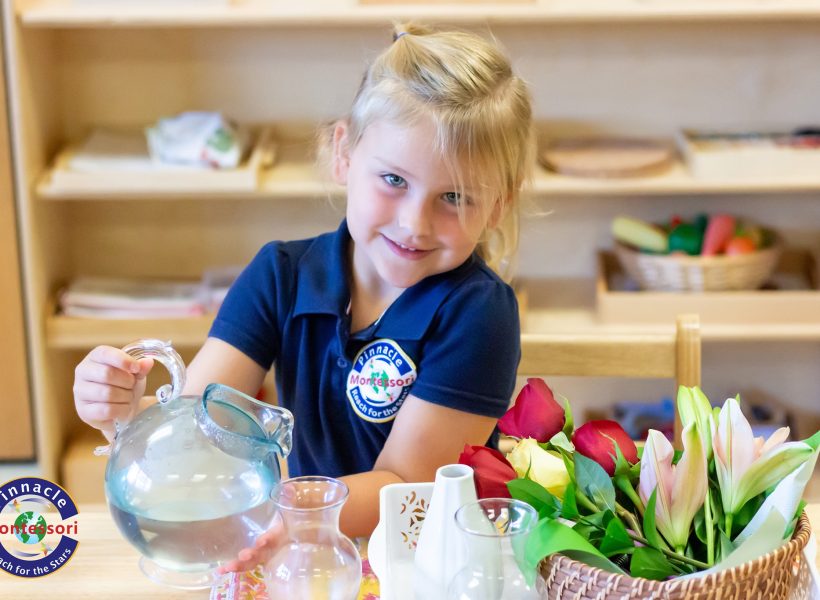
Children derive immense satisfaction from engaging in Practical Life activities, which not only mirror real-world experiences but also cultivate critical life skills such as order, coordination, concentration, and independence—qualities that will serve them well throughout their lives.
Our dedicated teachers introduce engaging manipulative materials that captivate children’s interest while guiding them through foundational concepts like one-to-one correspondence, numerals, the decimal system, and fundamental mathematical operations. In addition, children embark on an exciting journey of phonics, spelling, writing, language, and reading, ensuring a robust linguistic foundation.
Geography comes to life through interactive puzzle maps, landforms, and explorations of diverse countries, enriching their awareness of the world around them. To further enhance their educational experience, our curriculum embraces a wide array of subjects including Botany, Zoology, Science, Art, Spanish, Computer skills, and Music.
At Pinnacle Montessori, we are committed to empowering each child with the skills and knowledge they need to thrive in an ever-changing world. Join us in cultivating a bright future for our young learners!
The children at this age are ready to dive into a more detailed curriculum. A child’s mind is developing at enormous rate until around the age of ten. Maria Montessori called this the sensitive period or absorbent mind. Children are encouraged to work at their own rate and children are encouraged to work on a task as many times or as long as they need.
Our teachers are not the center of the room as in a daycare classroom. She is an observer first. She observes the task each child is doing and gives lessons to encourage more enriched curriculum after mastery of a previous lesson. The room is set up from left to right starting with the Practical life. This is important due to our society is set as a left to right society. For instance, we read and write from the left to the right. In the Practical life section, children are not only learning life skills, but are also working on fine motors skills, getting ready for the more advanced writing. In addition to these, lessons are very appealing to the child which helps in developing longer focus periods.
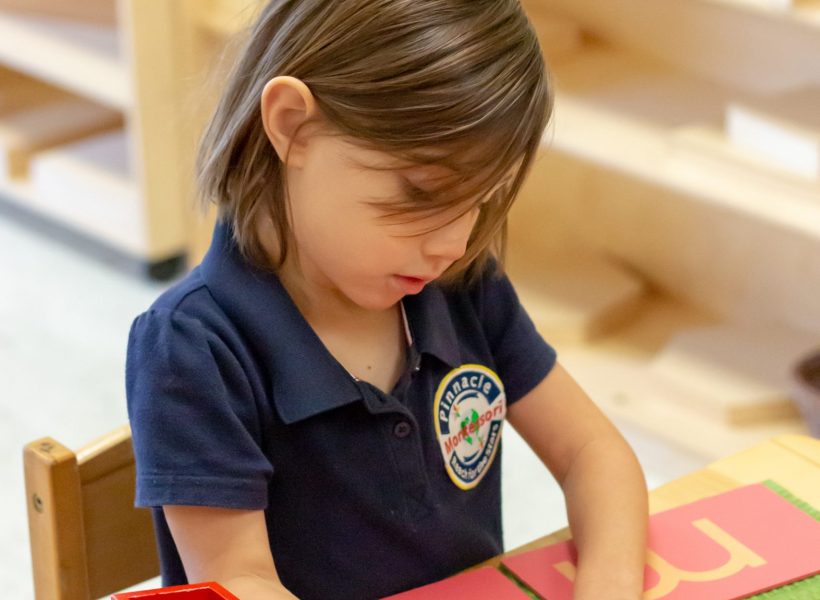
The second section is the Sensorial section. Children learn by using their senses and this section is for heightening those senses. It is also the beginning of future geometric tasks. The materials are very visibly pleasing for the visual learner, as well as pleasing to the touch for the tactile learner. This section helps the child be aware of their full environment which in turn opens their minds up to more advanced thinking.
Once children show the art of focusing, then they advance into the Language, Math, and Cultural sections. Even when they continue into these sections, they will still work on the Practical Life and Sensorial works. This is important for the children’s full enriched development. For instance, children may have an academic ability for more advanced work, but still not quite developed fully with their fine motor skills of writing or cutting. Having these sections constantly interchanging allows children to develop at the rate appropriate for them. In the Language section, children work with phonetic sounds and handwriting skills getting ready for future reading and writing. This is done with very visual pleasing concrete materials.
In addition, as they explore into reading, children learn the beginning, basic parts of speech through stories and concrete materials.
Math is taught from a global view such as what is a number and place value using concrete materials, to a more specific view in the abstract such as facts.
In the Cultural section, children learn Zoology: the basic animal groups and parts, Botany: parts of plants as well as environment appreciation, and Geography: learning all the continents and their parts as well as specific landforms. In addition, there is a Peace curriculum that promotes understanding and respect for themselves and others and Art appreciation. Majority of the educational experience for this level is in the concrete form, meaning use of materials to understand the concept.
Unlock a world where your child can excel both academically and emotionally.
18617, Weiss Ln & Aventura Ave, Bldg 1 Pflugerville, TX 78660
Address:
811 S Central Expressway, Suite#306
Richardson, TX 75080
Call: 1-866-333-6867

The Pinnacle Montessori School is committed to ensuring that its services are provided in a non-discriminatory manner without regard to race, color, religious creed, disability, handicap, ancestry, national origin, age, sex, or limited English proficiency.